*** VISIT MATTVEASEY.COM FOR NEW ITEMS ***
Showing posts with label Curt Schilling. Show all posts

Saturday, August 3, 2019

Phillies honor Bobby Abreu with place on the Wall of Fame

Embed from Getty Images
Bobby Abreu joins the immortals on the Phillies Wall of Fame

The Phillies are honoring 1998-2006 outfielder Bobby Abreu prior to the game on Saturday night against the Chicago White Sox by enshrining him on the franchise Wall of Fame.
In a special pre-game ceremony, numerous past Wall of Fame honorees are expected to be on hand, including the franchise’ all-time greatest player, Mike Schmidt.
Abreu played in parts of nine seasons with the Phillies from 1998-2006. He is currently 2nd in walks, 4th in doubles, 7th in extra-base hits and stolen bases, 10th in runs scored, 11th in home runs and RBIs, and 14th in hits on the Phillies all-time leader boards.
His .303 career batting average across 1,353 games with the Phillies is the second-highest of any player who has performed with the team over more than half a century, trailing only the .309 mark produced by fellow Wall of Famer John Kruk. His .416 on-base percentage is the fourth-best of any player during their Phillies career, and Abreu’s .928 career OPS with the Phillies is second in franchise history only to the great Hall of Famer and Wall of Famer, Chuck Klein.
Abreu is a native of Venezuela who was signed by the Houston Astros as a 16-year-old amateur free agent in August 1990. He received his first big-league promotion for a 15-game cup of coffee in September 1996.
He appeared twice against the Phillies that month, lining out to center fielder Ricky Otero as a pinch-hitter for Billy Wagner in a 10-8 Phillies victory at the Astrodome on September 11 in his first game against them.
In 1997, Abreu made the team out of spring training, and stayed with Houston through May. He returned for five games in July, and then was called up again in September, appearing in another 14 games. Against the Phillies he went 4-17 with two runs and two RBIs over five games. He would also pinch-hit, going 1-3, in all three games of the Astros sweept at the hands of the Atlanta Braves in the NLDS.
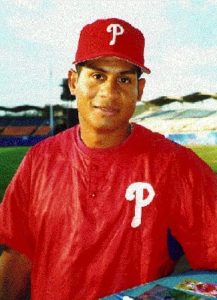
Abreu as a 24-year-old in his first season with the Phillies in 1998.(Roger H. Rangel)
That fall, Major League Baseball expanded to include a pair of new teams, the Arizona Diamondbacks and Tampa Bay Devil Rays (now just “Rays”) and an Expansion Draft was held. Abreu, left unprotected by the Astros, became the sixth player chosen overall, the third by Tampa Bay.
Abreu would never play a single game with those original Devil Rays. In fact, he would never get to the Sunshine State at all. On the same day that he was selected in that draft process, the Phillies traded away shortstop Kevin Stocker to acquire Abreu from Tampa.

Saturday, December 29, 2018

Former Phillies Scott Rolen, Curt Schilling deserve Hall of Fame enshrinement

Embed from Getty Images
Rolen was the 1997 NL Rookie of the Year with the Phillies

Just a little more than three weeks from now, on January 22, 2019, the Baseball Hall of Fame will announce the names of those voted in to the Class of 2019.
Based on publicly revealed ballots making up 1/3 of the total eligible voting members of the Baseball Writers Association of America, it appears certain that Mariano Rivera, Edgar Martinez, and former Blue Jays and Phillies ace Roy Halladay will certainly make the cut.
It will be a close call for former Baltimore Orioles and New York Yankees stud pitcher Mike Mussina. And a pair of players still be punished for their involvement with PEDs, Barry Bonds and Roger Clemens, are also receiving strong support but are likely to fall just short this time around.
Two players who will not get in this year, but who each deserve to be enshrined, are former Philadelphia Phillies pitcher Curt Schilling and third baseman Scott Rolen.
Schilling was running at around 72.9% of the votes received and made publicly available by early on Saturday afternoon, January 29, 2018 as tabulated by Ryan Thibodaux. Rolen was at just 19.4% of those publicly announced votes. It takes a minimum of 75% support for a player to be elected for enshrinement.
Under the current voting rules, players must have completed participation in ten seasons in order to become eligible for consideration. The player must then have been formally retired from Major League Baseball for five full seasons. Players who pass away within that five-year period are eligible six months after their death.
If a player does not receive the 75% of the votes needed in order for election, they can remain on the Hall of Fame ballot for nine more years. However, if a player received less than 5% support in any voting year they are dropped from the ballot and will received no further consideration until a special committee process can evaluate them.
For Schilling, this marks his seventh year on the ballot. A year ago, he finished with 51.2% of the vote. That was up from 45% in 2017, and just 39.2% in 2015. This is just Rolen’s second year on the ballot after receiving 10.2% of the vote a year ago.

THE CASE FOR CURT

Schilling enjoyed a storied 20-year career in Major League Baseball. He began as a reliever with the Baltimore Orioles (1988-90) and Houston Astros (1991) before receiving his big break.
Just as the 1992 season was set to open, the Philadelphia Phillies obtained Schilling in trade from Houston in a straight-up deal for Jason Grimsley. Phillies skipper Jim Fregosi would insert him into the starting rotation in mid-May, and there he would stay.
Over nine seasons with the Phillies from 1992-2000, Schilling would go 101-78 with a 3.35 ERA and 1.120 WHIP. He allowed just 1,444 hits over 1,659.1 innings with 1,554 strikeouts across 242 appearances, 226 of those as a starter.
Schilling was an NL All-Star for three consecutive seasons from 1997-99 while with the Phillies. The big right-hander also finished fourth in the 1997 NL Cy Young Award voting after a season in which he won 17 games and led baseball with 319 strikeouts for a team that won just 68 games.
It was with the 1993 Phillies magical NL pennant-winning team that Schilling took the first steps in what became one of baseball’s all-time greatest careers as a postseason performer.

Wednesday, December 26, 2018

My 2019 IBWAA Baseball Hall of Fame ballot

Embed from Getty Images
Former Phillies star Jim Thome was among those voted into the HOF last year

As a lifetime member of the IBWAA (Internet Baseball Writers Association), I have the honor of being involved in the organization’s annual Hall of Fame voting process. This is my fifth year with a ballot, and my selections were turned in about two weeks ago.
The IBWAA voting process does not earn a player a plaque at Cooperstown. It does, however, allow a group of well-informed voters to express their opinion as to which players are deserving of the ultimate honor for their baseball career. You can consider it a formal endorsement from baseball writers and bloggers who represent dozens of internet sites.
I had decided over the last couple of years to break my ballot down into three segments. “Hall of Fame” players are those who, for me, are obvious, or whom I evaluated from previous years and decided were worthy.

“Future Consideration” names are not so obvious to me, but are strong enough candidates that I will continue to evaluate them moving forward. Finally, “Not Hall of Famer” guys are those who just don’t make the cut for me and will not in the future.
In 2017, eight players received my IBWAA vote: Barry Bonds, Roger Clemens, Trevor Hoffman, Mike Mussina, Manny Ramirez, Ivan Rodriguez, Curt Schilling, and Larry Walker. Both Rodriguez and Vladimir Guerrero, who I had on my “Future Consideration” list that year, were voted in by the full IBWAA membership.
Last year just five returning players received my vote as a “Hall of Fame” player: Bonds, Clemens, and Schilling once again, as well as two newcomers to the ballot: Jim Thome and Chipper Jones.
On my “Future Consideration” list from the 2018 ballot were Hoffman, Mussina, Walker, Ramirez, Scott Rolen, Gary Sheffield, Billy Wagner, Lee Smith, Johnny Damon, Sammy Sosa, Jeff Kent, Fred McGriff, Omar Vizquel, Jamie Moyer, Andruw Jones, and Johan Santana.
The IBWAA membership honored six players in the final vote a year ago. Bonds and Clemens each finally got in, joined by Thome, CJones, Mussina, and Hoffman.
While the BBWAA only allow their eligible Hall of Fame voters to cast ballots for up to 10 players, the IBWAA has a 15-player limit. I decided after looking over the names to cast a wide ballot this year. Bottom line, I simply felt generous.


MY 2019 IBWAA BALLOT

My list for the 2019 IBWAA ballot was led by Schilling, the only player who has been a definite, no-doubt “Hall of Fame” player for me in both of the last two years but hasn’t made it as yet.
Two newcomers on this year’s ballot were considered by me to be no-doubt “Hall of Fame” players. Both Mariano Rivera and Roy Halladay thus received my vote as well.
I had decided early-on to bump up two players from last year’s “Future Consideration” list who were back on the 2019 IBWAA ballot, Walker and Rolen, to receive my vote.

Friday, November 23, 2018

11 with connections to the Phillies have a 2019 shot at the Baseball Hall of Fame

Embed from Getty Images
Schilling (R) has already joined Schmidt (L) and Carlton (C) in the Phillies Wall of Fame

Ballots for nominees to the 2019 Baseball Hall of Fame class were received this past week by eligible voters with the Baseball Writers Association of America.
There are 35 players on the ballot this year. That total includes 15 holdovers from last year’s ballot and 20 newcomers. Among those nominees there are nine who played with the Phillies at one time or another.
Three returning Phillies players on the BBWAA ballot this year are Curt Schilling, Billy Wagner and Scott Rolen.
Schilling spent most of his Phillies career from 1992-2000 as a starter, including as the ace of the 1993 NL pennant-winning squad. Wagner was a lights-out closer for the Phillies during the 2004-05 campaigns. Rolen was the 1997 NL Rookie of the Year and four-time Gold Glove third baseman during his 1996-2002 Phillies years.
The half-dozen newcomers to the BBWAA Hall of Fame ballot for 2019 are pitchers Roy Halladay, Roy Oswalt, and Freddy Garcia. Infielders Placido Polanco and Michael Young and outfielder Juan Pierre also spent time with the Phillies and are on the ballot this year as position players.

PHILLIES NEWCOMERS TO THE BALLOT

Garcia (34.4 WAR), Young (21.4) and Pierre (17.1) are very likely to fall off the ballot after this round of voting. Any player who does not receive support from at least 5% of the voters is removed from the ballot, and it is hard to imagine either player reaching that mark. Oswalt and Polanco each have a chance to receive at least enough support to remain on the ballot for a second year.
Oswalt was part of the 2011 ‘Four Aces’ starting pitching rotation that led those Phillies to a franchise-record 102 regular season victories. The righty had come over from Houston at the 2010 non-waiver trade deadline following a strong decade with the Astros during which he was a three-time NL All-Star and finished among the top five in NL Cy Young Award five times.
Over a 13-year career in Major League Baseball with three organizations, Oswalt went 163-102 with a 3.36 ERA and 1.211 WHIP. He registered an excellent 3.56 K:BB and accumulated a 50 career WAR mark.
Polanco was obtained in a 2002 trade with the Saint Louis Cardinals for Rolen. He would start at second base for the Phillies from 2002 until being traded to the Detroit Tigers during the 2005 season, making way for Chase Utley to take over the position.
With the Tigers, Polanco became an AL All-Star and won two Gold Gloves and a Silver Slugger. He was named the Most Valuable Player of the 2007 ALCS and received AL MVP votes in both 2007 and 2009.
Polanco returned to the Phillies after the 2009 season as a free agent, playing third base from 2010-12. He was a 2011 NL All-Star and captured this third career Gold Glove Award at a second position. Polanco finished with 2,142 hits over 16 big-league seasons with a 41.5 WAR mark.
Halladay has an excellent shot at enshrinement in his first year on the ballot. He accumulated a 64.3 career WAR mark to go along with a 203-105 record, 3.38 ERA, 1.178 WHIP, 3.58 K:BB and a host of signature accomplishments and awards.
The big right-hander was the AL Cy Young Award winner in 2003 with the Toronto Blue Jays and the NL Cy Young Award winner in 2010 with the Phillies. He finished as runner-up for the award with both teams as well.
Halladay was an eight-time All-Star and three-time 20-game winner (won 19 twice) who led his league in innings pitched four times, shutouts four times, and in complete games on seven occasions.

Friday, August 3, 2018

Remembering the 1993 NL champion Phillies in their silver anniversary season

Embed from Getty Images
Daulton was the acknowledged clubhouse leader of the 1993 NL champions

The Philadelphia Phillies are officially feting the 2008 World Series championship team this weekend.
On the 10th anniversary of the historic season which concluded with that team winning the second title in franchise history, it is wholly understandable and appropriate.
However, there is another beloved Phillies team celebrating a big anniversary this year.
In fact, as someone who has been following the team closely since Veteran’s Stadium opened in 1971, I’ve always maintained that the other anniversary team provided the most fun single Phillies season that I ever experienced.
Sure, the 1980 and 2008 Phillies teams both won the World Series. I attended Game Two of the 1980 Fall Classic as an 18-year-old. I was at the parade celebrations for both championship teams.
I was inside JFK Stadium in October of 1980 when Tug McGraw told New York to “take this world championship and stick it!” I was videotaping at 15th & JFK and captured a fan making a memorable climb up a light pole on Halloween in 2008.
But for all the drama, excitement, and ultimate thrill that those two clubs provided, there was never a more fun Phillies season from start to (almost) finish for me than the one provided by the 1993 team.
It almost seems lost in all the excitement over the 10th anniversary of the 2008 club, but this is now the silver anniversary for the 1993 National League champion Philadelphia Phillies team.
Yes, it has been 25 years now since that mullet-wearing, scruffy-bearded, ‘Macho Row’-led crew stormed through baseball. In a March 2012 piece, Mike Bertha at Philadelphia Magazine summed up that unforgettable season perfectly:
“It began with a bench-clearing brawl at spring training. Then, over the course of 103 total wins, 49 extra innings, 12 playoff games and some late nights (or, more accurately, early mornings), the 1993 Phillies seduced the city. Fans spent the summer flocking to the Vet to watch their appropriately nicknamed “Animal House,” both captivated and agog as the Phillies stampeded through the National League and then marched through Atlanta to earn a date with the defending-champion Toronto Blue Jays in the World Series.”


The Darren Daulton Foundation operates today in the name of, and as a memorial to, the namesake captain of that Phillies team. The foundation provides financial assistance to those who suffer from brain cancer and brain tumors. On June 8, they held a reunion celebration for the 1993 team.
Our own Kevin McCormick here at Phillies Nation reported on the event and those in attendance back in June:
“…the pennant-winning team showed up for the event, including: Tommy Greene, Jim Eisenreich, Larry Bowa, Milt Thompson, Ben Rivera, Mickey Morandini, David West, Tony Longmire, Curt Schilling, and even Danny Jackson who arrived after throwing out the first pitch at the Phillies-Brewers game across the street. Fans in attendance got to meet the players, take pictures, get autographs, and chat with the guys throughout the night.”
Morandini, who shared second base duties with Mariano Duncan, eventually became a minor league manager and then a big league coach with the Phillies. He remains on the payroll as a popular club ambassador.
Five of the men who were in uniform and playing important roles that summer are no longer with us, including Daulton. The catcher and leader of that ball club died a year ago this coming Monday following a four-year battle with brain cancer.

Saturday, December 9, 2017

My 2018 IBWAA Hall of Fame Ballot

Thome and Jones among five to receive my 2018 HOF vote
This past year marked a major change in direction as far as my baseball writing was concerned. For the previous three years, I wrote almost exclusively on the national pastime.

As the Fall of 2017 arrived, I decided to return to writing across the broader spectrum of politics, religion, entertainment, and social issues.

Baseball is always going to hold a special place in my heart and life, especially in regards to my hometown Philadelphia Phillies.

For anyone who has enjoyed my baseball writing in the past, rest easy. I am going to continue writing on the sport here at my website from time to time. You can enjoy those pieces, including all from the past, by clicking on the "Baseball" category from the website toolbar.

As a lifetime member of the IBWAA (Internet Baseball Writers Association), I have the honor of being involved in the organization's annual Hall of Fame voting process. This was my fourth year with a ballot, and my selections were returned just this past week.

The IBWAA voting process does not earn a player a plaque at Cooperstown. It does, however, allow another block of informed voters to express their opinion as to which players are deserving of that ultimate career honor. You can consider it a formal endorsement from the Internet baseball writers and bloggers.


A year ago for the 2017 IBWAA Hall of Fame voting, I broke down my ballot into three categories: Hall of Famers, Under Future Consideration, and Not Hall of Famer. I am doing the same for this piece on the 2018 ballot, and will continue that process into the future.

There were 31 eligible players on last year's 2017 ballot. Eight of those players received my vote as a Hall of Famer: Barry Bonds, Roger Clemens, Trevor Hoffman, Mike Mussina, Manny Ramirez, Ivan Rodriguez. Curt Schilling, and Larry Walker.

Rodriguez and Vladimir Guerrero, who was on my "Future Consideration" list a year ago, were each voted in by the IBWAA in 2017. Both players received 175 votes (84.54%) to gain the honor of our HOF endorsement. Mussina, Hoffman, Bonds, and Clemens all received more than 70% of the vote, falling just short of the 75% requirement for endorsement.

This year, I was more frugal with my own vote, casting a ballot for just five players. In doing so, I left off three players who received my vote a year ago: Walker, Ramirez, and Hoffman. 


Frankly, I don't really enjoy taking a vote away from these players. It's not that I no longer feel they are worthy. I made a personal decision this year to "tier" my deserving choices. The five players who did receive my vote are, for me, clearly ahead of those three.

A year ago there were 31 players on the ballot. After voting for eight, I listed another seven under consideration, and rated 16 as not deserving. You can see here that the number of players who I will be considering in the future has grown considerably.

There are three videos accompanying this piece. I would recommend that you view each of them for more information on the HOF 2018 nominees and process. The middle video on Schilling's worthiness is particularly revealing. 

Here is my breakdown of the 2018 IBWAA Hall of Fame ballot. You will also absolutely have your own opinions, and I would love to hear them. Among the below nominees who were on the 2018 IBWAA ballot, which would receive your vote to the Baseball Hall of Fame?

Saturday, December 31, 2016

My 2017 IBWAA Baseball Hall of Fame Ballot

The Internet Baseball Writer’s Association of America (IBWAA) conducts voting in December of each year for its Baseball Hall of Fame.
This process is conducted in much the same manner as the formal BBWAA voting, which results in players being inducted into the Baseball Hall of Fame at Cooperstown.
The IBWAA was born on the Fourth of July in 2009. As described at the association website, the organization was formed “to organize and promote the growing online baseball media, and to serve as a digital alternative to the Baseball Writers Association of America (BBWAA).” 
The BBWAA is made up of writers who have covered the game for “traditional” media. This usually means of the print variety, such as newspapers. 
Meanwhile, coverage of the game has exploded beyond such traditional means over the last two decades.
Baseball coverage has now expanded to purely digital websites and blogs. Due to this expansion, a vibrant and vital new resource is available to all fans of the sport. 
Hence, the IBWAA organizes internet writers, columnists, and bloggers who might otherwise be shut out of the aging print media structure.

Tuesday, November 3, 2015

Phillies Fall Classics VIII: 1993 World Series Game Five

It appeared as if the clock was about to strike midnight on the 1993 Philadelphia Phillies worst-to-first Cinderella season. 
After splitting the first two games in Toronto, the Blue Jays had won the next two games at Veteran’s Stadium to take a 3-1 stranglehold on the World Series.
In Game Three, the Jays’ powerful lineup had laid waste to the Phillies, demolishing them by a 10-3 final. 
But what happened in Game Four was even more debilitating to the Phils’ collective spirit.
After the Blue Jays scored three times in the top of the first off Tommy Greene, the Phillies bats decided that they were not going to let Toronto run away and hide again, answering with four of their own off Jays’ starter Todd Stottlemyre.
Through four innings, the Phillies led 8-7 in what was developing as a slugfest. Little did the fans that night at The Vet know, they hadn’t seen anything yet. 
Over the next three innings, the Phils powered their way to a 6-2 advantage, taking an overall lead of 14-9 on the scoreboard.
Up by five runs going to the top of the 8th inning, the Phillies were just six outs away from tying the World Series at 2-2. 
And then the Blue Jays’ bats, silent for most of the previous four innings, finally awoke, and with a vengeance.
Toronto scored six times in that top of the 8th to re-take the lead at 15-14. Just as suddenly, perhaps demoralized by the unrelenting pressure, the Phillies’ bats went silent and scoreless. 
ESPN would rank this 9th on their “10 Greatest World Series Games” list.

Monday, August 31, 2015

Ex-Phil Schilling a Witch Hunt Victim

By now, most people are aware that former Phillies 1990's pitching ace Curt Schilling was recently suspended from his gig covering the Little League World Series for ESPN, and removed for a week from his Sunday Night Baseball broadcast on the network.

What most are unaware of is the true reason: a "witch hunt" mentality which saw his actual actions distorted completely by the numerous people who dislike his outspokenness and his politics.

Now the rest of this post is going to deal with difficult topics like "math" and "truth", so if you have a rough time with either of those, or prefer your "sports" in the tame realm of scores and trades and such, you might want to just move along.

But if you genuinely care about why it is important that you NOT blindly follow the anti-Schillites, not allow yourself to take part in this partisan witch hunt, then please, read on.

Let's first address what actually happened to cause the suspension. Schilling was accused of making, or more appropriately sharing, an "anti-Muslim" statement.

He was further charged by some with comparing Muslims to Nazis. Some never actually state what it is specifically that he said or shared, just that whatever it was, was "offensive" in some way.

Here is the specific post that caused all of the uproar, unfiltered:

Tuesday, February 3, 2015

Mitch Williams Interview

Embed from Getty Images
Williams (center) during his stint as an analyst with the MLB Network

Mitch Williams is one of the most colorful, controversial, and popular athletes in Philadelphia sports history. "The Wild Thing" who heroically shut down the Braves to clinch the 1993 National League Pennant, then became a publicly vilified goat on yielding Joe Carter's World Series-winning homerun just 10 days later.
Williams rose from the ashes of that emotional '93 devastation to eventually be forgiven and embraced again by Phillies fans, and ultimately beloved by them. He did it by never shirking responsibility, and by always displaying openness and candor in handling the situation.
I was fortunate enough to be able to interview the former Phillies closer this week. In our conversation, Mitch showed that he is as feisty, frank, and competitive as ever.
We covered a wide range of topics, from his current internet talk show "Unleashed with Mitch Williams", to last year's incident that resulted in his being fired by the MLB Network, to his opinion on the current Phillies bullpen of Jonathan Papelbon, Ken Giles, Jake Diekman, and Justin De Fratus.
Along the way there were detours to Curt Schilling's Hall of Fame worthiness, his relationship with Lenny Dykstra, and even a more recent run-in with former Phils pitching coach Rich Dubee involving both Diekman and Phillies pitching great Roy Halladay.

Saturday, December 20, 2014

Philography: Darren Daulton

Embed from Getty Images
Perhaps the greatest "Captain" in Phillies history, Darren 'Dutch' Daulton

The Philography series continues with the final weekly installment before moving to a bi-monthly (every two weeks) schedule during the off-season. This week we take a look at the career of 1993 ‘Macho Row’ team Captain, fan favorite Darren ‘Dutch’ Daulton.
Darren Daulton was born on January 3rd, 1962 and raised in the same town of Arkansas City, Kansas. He attended his hometown Arkansas City High School, was a star athlete, and became the Philadelphia Phillies 25th round selection in the 1980 Draft as an 18-year old.
Over the next few years, Daulton rose through the Phillies system a level at a time, first to Rookie league Helena, then Low-A Spartanburg, and then to High-A Peninsula. At each stop, his playing time and his productivity increased.
By 1983 at age 21, Daulton had reached the AA level Reading Phillies, where he raised his game another level. He had career highs in nearly every category, and showed

Wednesday, December 1, 2010

A Decade of Parity and History

In western historical terms, there was no year '0', so most people realize that an official decade truly runs from the year ending in '1' through the 10th year.

This means that 2001 opened the true first year, and the recent 2010 season ended the final year of the first decade of the 21st century.

For all of the talk about payrolls in baseball and a fear of competitive imbalance, here is the bottom line fact as it relates to that recently completed first decade: 9 different teams won the World Series.

The only franchise that was able to win multiple World Series titles was the one that opened the decade with a supposed jinx or curse, one that hadn't won in 90 years. That franchise was the Boston Red Sox, who won in 2004 and then again took the crown in 2007.

League or Divisional assignments didn't matter this past decade either. The two leagues evenly split the World Series victories at 5 apiece, and teams from every division won titles. The Phillies ('08) and Marlins ('03) from the N.L. East, the Cardinals ('06) from the N.L. Central, the Diamondbacks ('01) and Giants ('10) from the N.L. West gave the National League 5 titles. In addition to Boston's two titles, the Yankees ('09) joined from the A.L. East, the White Sox ('05) won from the A.L. Central, and the Angels ('02) from the A.L. West to give the American League 5 titles as well.