*** VISIT MATTVEASEY.COM FOR NEW ITEMS ***
Showing posts with label Philadelphia Athletics. Show all posts

Sunday, February 3, 2019

In 1902, the new Philadelphia baseball rivalry spilled over to pro football

Embed from Getty Images
The 1902 Philadelphia Athletics  (pic) rivalry with the Phillies spilled over to pro football

Today is Super Bowl Sunday, one of the biggest sporting days in the world. It is estimated that well over 100 million people worldwide will tune in to watch the New England Patriots and Los Angeles Rams battle to become this year’s champions of the National Football League at some point.
The game won’t hold the same edge-of-your-seat passionate interest that last year’s game did here in Philadelphia. A year ago, the Philadelphia Eagles defeated New England in a thrilling 41-33 contest to capture the first-ever Super Bowl crown in franchise history.
As soon as this year’s game ends and the last of the chicken wings, pizza, and beer has been consumed here in Philly, local sports fans will begin to much more seriously consider the upcoming Philadelphia Phillies baseball season.
The Phillies pitchers and catchers are scheduled to report to Clearwater, Florida exactly ten days from today for the official start of 2019 spring training camp. The position players will join later that week, and the first game of the Grapefruit League season is scheduled for Friday, February 22.
A fun fact that most Phillies fans are probably not aware of is that there was once a Philadelphia Phillies professional football team in town. In fact, there is a direct link, as the football team was actually owned by the baseball team.
In 1902 a first-ever attempt to form a pro football league took place right here in Pennsylvania. And in fact, that formation was a direct result of the beginning of the baseball wars the previous year with the formation of the new American League.
The Phillies had been in existence as members of the National League since the 1883 season, though they were often referred to as the ‘Philadelphia Quakers’ during their first seven seasons. The NL had been founded seven years earlier, on February 2, 1876.

Ben Shibe (2nd from left, front row) was the original owner of the Philadelphia Athletics – both the baseball and football versions. (Bain News Service/WikiCommons)
Founded on January 28, 1901 the American League set out to become an alternative “major league” and expand opportunities for both players and fans to participate in the game at the highest levels.
During the 1901-02 seasons there was outright war between the more established “Senior Circuit” of the NL and the new kids on the block, the “Junior Circuit” of the AL. The two would finally establish a ‘Pax baseball’ following the 1902 season, with establishment of rules regarding player contracts as well as a World Series between champions of the two leagues.
But while that initial war was still being fought, the idea of professional football was brought into the fray. Phillies owner John Rogers started a football team named after his baseball club. Ben Shibe, owner of the Philadelphia Athletics in the AL, decided to start one of his own in response.
Out in Pittsburgh, the Homestead Library & Athletic Club had what was considered the best football team in the nation made up of professional paid players. The team was funded by Pittsburgh Pirates minority owner William Chase Temple, and had not lost a game during either their 1900 or 1901 schedules.
Football promoter Dave Berry took many of those Homestead players and formed a pro team called the Pittsburgh Stars. The team is believed by many to have remained funded by either Temple or the Pirates majority owner, Barney Dreyfuss.

Tuesday, November 15, 2016

Ty Cobb Ends His Career in Philadelphia

Ty Cobb is one of the greatest players in baseball history, but few are aware that the Hall of Fame legend finished up his long career as a member of the Philadelphia A’s, the franchise that would later relocate to become the Oakland Athletics.
Cobb is rightly remembered as a Detroit Tigers superstar. He played for 24 seasons in the big leagues, and 22 of those were with the Tigers. Nicknamed “The Georgia Peach”, Cobb was born in the Peach State in 1886 and grew to love the game of baseball at an early age.
The story of Cobb’s early life, brief minor league career, and a family tragedy that had lasting implications is well told in the book “Ty Cobb: A Terrible Beauty” by Charles Leehrsen, and his SABR bio by Daniel Ginsburg.

Cobb With the Tigers

Cobb blew no one away during his rookie rookie season with the Tigers in 1905. The 18-year-old was a boy among men, and his stat line shows just how much that difference meant. He hit for just a .240/.288/.340 slash over his first 164 plate appearances that year.
But by the following season in 1906, Cobb had established himself more, and in 1907 at age 20 he exploded, leading the big leagues in hits, RBI, batting average and total bases, and the American League in steals, slugging, OPS and OPS+.
It was the first of many such seasons for Cobb. Over the 22 years in Detroit he would lead the majors in hits seven times, steals four times, runs scored and RBI three times, and triples and doubles twice. He even led baseball in homers during the 1909 season.
He won the American League MVP Award in 1911, and received Most Valuable Player votes in each of the next three seasons as well.

Sunday, June 12, 2016

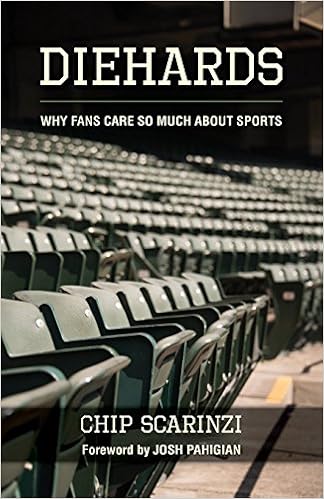
Book Review: "Diehards: Why Fans Care So Much About Sports"

If you are a baseball fan like me, you enjoy all aspects of the game. Not just the more analytical, statistics-based evaluations of recent years, or the classic excitement of a dramatic game, series, or season, but the whole enchilada.
The history of the game and the background stories of the players and other individuals involved fascinate me. 
The best resource to obtain information of this type can often be a well-written book on a particular subject.
All of the reading that I have done over decades following the game finally led me to this idea for the introduction of a "book reviews" series, with coverage of both the Phillies in particular and baseball in general.
In moving forward with the series, I will mostly focus on material written about the Fightin' Phils specifically. But if something influences me enough while only barely touching on the team, will highlight those as well.
I wanted to begin the series with something that  included the Phillies, but also would be of interest to the wider audience of baseball fans. I believe that I may have stumbled upon the perfect choice.
As a big fan of the team and the game in the passionate sports town of Philly, the aspect of fandom itself has always fascinated me. This led to my interest in introducing you to the 2015 book "Diehards: Why Fans Care So Much About Sports" by Chip Scarinzi.
Chip is one of us, a self-described "lifelong, diehard Philadelphia Phillies fan" who grew up in New Jersey

Tuesday, July 14, 2015

Philadelphia's First MLB All-Star Game

The first All-Star Game ever played in Philadelphia was also a first for Major League Baseball. 
The game, played at Shibe Park on July 13th, 1943 was the first midsummer classic to be scheduled at night.
Being a "first" involving the illumination of a ball game in the dark was nothing new for Shibe, which had also been the site of the first-ever night game in the history of the American League back in May of 1939.
Shibe Park was the first steel-and-concrete ball park in the game's history, and was home to the American League's Philadelphia (now Oakland) Athletics from 1909-1954. It was located in a neighborhood of mostly Irish immigrants then known affectionately as Swampoodle.
The then-34 year old facility could be found even more specifically along Lehigh Avenue and north, between 20th and 21st Streets. 
In the spring of that 1938 season, the park had taken in a new tenant. The National League's Phillies moved in that year from old Baker Bowl, which sat just 5 blocks away at Broad & Huntingdon.
The Phillies legendary Hall of Fame outfielder and broadcaster, Richie Ashburn, would say of Shibe: "It looked like a ballpark. It smelled like a ballpark. It had a feeling and a heartbeat, a personality that was all baseball."


Though the two teams would share Shibe Park for 17 seasons, it was the A's playing hosts for the game, and so the AL would be the home team. 
And so it was that on a warm, overcast July evening in the middle of World War II, and with rain threatening, baseball's best available players migrated to North Philly.
On Mutual Radio, the game was broadcast by announcers Red Barber, Mel Allen, and Bill Corum all across the United States. 
The managers for the two teams were two of baseball's very best, representing what have become the game's preeminent franchise in each league.
All-Star Game
A game program from the 1943 MLB All-Star Game played at Shibe Park in Philadelphia.
For the National League, it was Billy Southworth of the Saint Louis Cardinals. 
Southworth, in his 2nd stint as the team skipper, took over and led the team to a 49-20 record down the stretch in 1940, salvaging a 3rd place finish out of what had seemed a lost season, and in 1941 he guided them to 97 wins and a 2nd place finish.
That start of the second act of Southworth's Cardinals managerial career was only setting the stage. 
His teams from 1941-43 would win at least 105 games each season, taking all three NL Pennants and winning two World Series crowns. The 1942 Series win had earned him this nod as skipper of the NL All-Stars.
For the American League, it was legendary New York Yankees manager Joe McCarthy at the helm. 
McCarthy was a hometown boy, born and raised in Philadelphia. He idolized the A's 62-year old owner/manager Connie Mack, whose name Shibe Park would eventually take for its own as Connie Mack Stadium.
McCarthy knew how to handle stars, serving as the Yankees skipper from 1931-1946 during the careers of such legends as Babe Ruth, Lou Gehrig, Bill Dickey, Joe DiMaggio and more. 
His 1942 Yanks' squad had lost to Southworth's Cards in five games after winning the opener of the Fall Classic.
The two teams, and the two managers, were on a collision course for a rematch in October of 1943. But before they would get to that business, there was this summer exhibition under the lights taking center stage in the baseball universe.
As told by Baseball Almanac, McCarthy was "publicly accused of being flagrantly partial" to his Yankees players in the selection of his starting lineup for the All-Star Game in previous years. 
As a reply to those accusations, McCarthy would not use any of five Yankees sitting on his bench in the entire game.


In just his 2nd full season, and with fewer than 1,000 plate appearances in the big leagues, it was Southworth's young 22-year old star outfielder Stan Musial who would get his NL team on the board first.
Appearing in the first of what would be 24 straight All-Star Games, Musial knocked in Chicago Cubs 3rd baseman Stan Hack to put the NL up 1-0 in the top of the 1st inning.
In the bottom of the 2nd, the American Leaguers answered when Boston Red Sox 2nd baseman Bobby Doerr drove a 3-run homer out to left field off NL starting pitcher Mort Cooper of the Cardinals. 
Left fielder Dick Wakefield of the Detroit Tigers ripped an RBI double off Cooper in the 3rd, making it a 4-1 lead for the AL side.
"It looked like a ballpark. It smelled like a ballpark. It had a feeling and a heartbeat, a personality that was all baseball." ~ Whitey Ashburn, on Shibe Park
Cincinnati Reds' pitcher Johnny Vander Meer, who five years earlier as a 23-year old in his first big league season had set a record still never equaled by pitching back-to-back no-hitters, was victimized by the AL in the 5th for an unearned run thanks to an error by catcher Ernie Lombardi of the New York Giants, pushing the Junior circuit's lead up to 5-1.
"All
The elder DiMaggio, Vince would star in the 1943 All-Star Game after coming in as a pinch-hitter while brother Joe served during WWII.
At that point, the Vince DiMaggio show began. The older brother of Yankee star Joe DiMaggio, who was away in the war effort, Vince was in the middle of a successful 5-year run in a Pittsburgh Pirates uniform.
DiMaggio had entered the game as a pinch-hitter for yet another Cardinal, centerfielder Harry Walker. 
Staying in the game, DiMaggio would go 3-3 and score a pair of runs, including on his own 9th inning solo homerun off Red Sox pitcher Tex Hughson.
The homer by Vince D cut the AL lead down to 5-3, but Hughson, who had a nice 8-year career with Boston during the 1940's, settled down and retired the NL stars, preserving the victory for his team and earning a Save for himself.
Washington Senators pitcher Dutch Leonard, who started for the AL and went three solid innings, would get credit for the Win, which was the American Leaguers 8th in the 11 All-Star Games played to that point in history.
The appreciative Philly crowd let out a cheer with the final out of a game that took just over two hours to play. 
While they had missed Joe D, Ted Williams, and others who were off in the war effort, they had gotten to see some great stars, including aging Giants' slugger Mel Ott as a pinch-hitter in one of his final All-Star appearances.
Much as with tonight's 2015 MLB All-Star Game, the Phillies had just one lone representative in 1943. 
That player was journeyman 1st baseman Babe Dahlgren, who was in his lone season with the Phils, and who was playing for his 8th of what would ultimately be 10 teams during a 12-year career in the majors.
The host Athletics also had just one lone rep on the AL squad, 1st baseman Dick Siebert, who would hit just one homer in 558 at-bats for the A's during that 1943 season. Siebert played eight seasons with the A's in an 11-year MLB career.
It was the first MLB All-Star Game ever played in Philadelphia. It would not be the last, for either the city, or for the ballpark. 
Nearly a decade later, in 1952, the Phillies would be the hosts at Shibe in a 3-2 NL win that was also affected by the weather. That one would, in fact, be shortened to just five innings by the rains. 
In both 1976 and 1996, the Phillies would host National League victories at Veteran's Stadium in South Philly.

Monday, September 8, 2008

It's Just a Fantasy

If you know me, you know that I am a huge baseball fan. A lifelong Phillies fan, of course, and someone who played for and managed a local championship men's softball team for over a decade and a half.

As I got a bit older, I retired the old glove and bat, and moved into the fantasy game. Fantasy baseball has been one of my biggest hobbies over the past decade, particularly with a 'Keeper' league of which I am a part known as the 'Whitey Fantasy Baseball League'.

In this case, 'Whitey' refers to the man for whom the league is dedicated, Philly's own Rich 'Whitey' Ashburn. We have 16 players in the WFBL known to each other as GM's (general managers) of the 16 teams, which are all league-owned.

My own team, the Philadelphia Athletics, has been highly successful. My team has captured seven of the 11 pennants in our Paul Owens (East) Division, and one league championship during a history which began back in 1998.

That first summer saw the WFBL stock each of our team rosters for the first time with an original draft. Since then, players have been exchanged over the years through trading and a waiver-acquisition process. We are permitted to keep between 16-20 players every year, so you can actually build a team and keep it together if you like.

That original franchise-stocking WFBL Draft yielded me Scott Rolen and Derek Jeter as the first two picks. They became cornerstones, and I picked up later in the Draft such young studs as Billy Wagner and Andruw Jones.