*** VISIT MATTVEASEY.COM FOR NEW ITEMS ***
Showing posts with label Eddie Sawyer. Show all posts

Friday, June 26, 2015

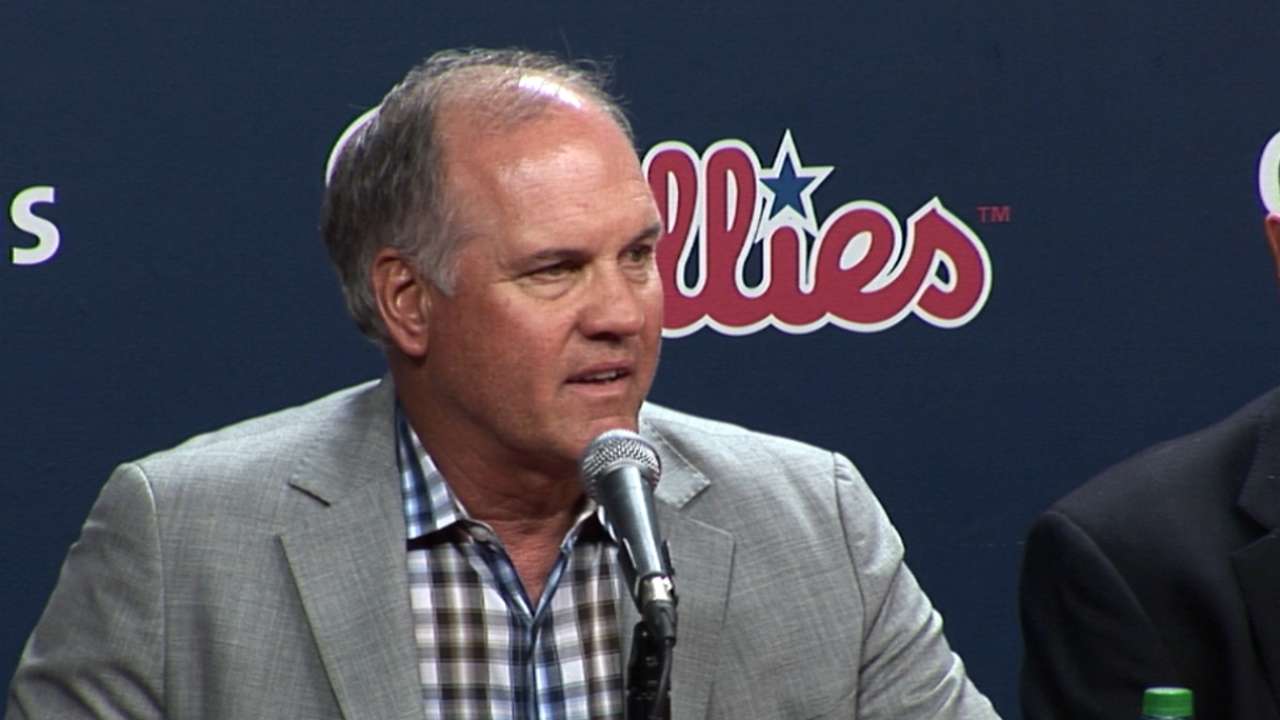
Ryne Sandberg Resigns: What Next for Phillies?

"This is a difficult day, a challenging day, and a tough day for myself. But I am stepping down as the manager of the Philadelphia Phillies."
With that fairly simple, straight-forward statement, Ryne Sandberg resigned his position as the skipper of the Phillies. 
He leaves the team having guided them to an overall 119-149 record in one full and parts of two other seasons.
Sandberg took over for previous manager Charlie Manuel in August of 2013, leading the club to a 20-22 record down the stretch of what became their first losing season in a decade. 
In his only full season a year ago, Sandberg's club went 73-89 and finished in last place in the NL East.
At the time of the resignation, Sandberg and the Phillies were 26-48 and buried in last place once again in the NL East. 
For the immediate future, such as the weekend series beginning tonight at Citizens Bank Park, the Phils will be led by Pete Mackanin, who was named the interim manager.
You have already seen many writers and media types step forward with their take on Sandberg's job performance, his approach, and the timing of this turn of events, some critical and some more supportive. 
My own take is that Sandberg was dealt a bad hand, and he played that bad hand poorly.
That said, I would caution anyone, and I have seen this opinion voiced, who thinks that Ryne Sandberg won't ever get another shot at a managerial job in Major League Baseball. 
Not only do I think that Sandberg could get a job, but I think there is a good chance that he will get a shot, and he just may succeed.
All Phillies fans have to do if considering why I feel this way is look into our franchise own somewhat recent past, remember a guy who fans were happy to see go by the name of Terry Francona
Tito managed the Phillies from 1997-2000, compiling a 285-363 record for a .440 win-loss percentage that was nearly as bad as the .428 managed by Sandberg.
We all know what happened after that. Francona took over the Boston Red Sox four years later. 
In his very first season at the helm, he guided Boston to their first World Series victory in 86 years. In 2007, Francona was at the helm as the Bosox then won yet another World Series crown.
From 2004 through last season, Terry Francona has managed in MLB with Boston and Cleveland in 10 of the last 11 years. He has yet to record a losing season, and his all-time managerial record now stands at 1239-1100, including those awful early Phillies clubs.
Ryne Sandberg was not only a player in the big leagues, like Francona, but even more, Sandberg was one of the best all-around players of his generation. He has been enshrined in the Baseball Hall of Fame, and is considered one of the greatest 2nd basemen of all-time.
He earned industry-wide praise when, wanting to manage following his playing career, Sandberg was willing to go down to the minor leagues and learn his craft. He earned his shot at the Phillies job with hard work and success there.
In six minor league seasons, his clubs went a combined 512-498. His first season team, the Peoria club in the Cubs system, went to the Midwest League title game. 
In 2010, Sandberg was named the Pacific Coast League Manager of the Year after an 82-62 season.
Hired by the Phillies as skipper at AAA Lehigh Valley, Sandberg guided that club to its first-ever postseason appearance in 2011, and was named as the Minor League Manager of the Year by Baseball America. 
In short, after a Hall of Fame playing career, Sandberg paid his dues as a minor league manager where he was extremely successful. Clearly, there is something there.
Sandberg also highlighted during his resignation press conference that he saw himself as "old school" in style. Perhaps that style simply doesn't mesh well with today's professional athletes, almost all of whom are making multiple millions of dollars each season.
This particular Phillies clubhouse has been noted by many in the media as leaderless, from a players perspective. It is never a good thing when the locker room has no voice willing to stand up as a peer and call players to accountability.
Much of the problem with these Phillies is that they are either aging, or limited, or injured. But whatever their individual circumstances, the vast majority are not self-motivators. The proof is in the results.
Sandberg did not help his own case, making a number of baffling moves, both in-game and in lineup decisions. He may have had good reasons for making those decisions, but if so, he rarely was able to communicate those in his post-game pressers. 
The fact may simply be one of inexperience in this position, and that he was overwhelmed by this particular job at this particular time.
Sawyer
"I'm 49, and I want to live to be 50." ~ Sawyer, the last Phils skipper to resign in 1960.
That Sandberg was unable to motivate this particular group may not necessarily mean that he cannot motivate any group at all. 
Remember, this team was left for dead before it ever got out of the starting gates. Everyone inside and outside that clubhouse expected them to lose, probably big, and to see a number of key veterans traded away.
The longer the losing has droned on, and the longer that the situation with players having to live with constant trade rumors over their heads has dragged on, the more the morale seems to have deteriorated.
"I'm 49, and I want to live to be 50.
That was the statement made by the last Phillies manager to resign. That manager was Eddie Sawyer, all the way back in 1960. So this has not happened for over a half-century.
These Phillies have a lot of problems. The skipper was one of them, but he was not the only one, and he was far from the worst one. Those other problems remain, from the GM to the President to the players. 
Those other problems will need to be dealt with before this franchise can begin to seriously turn around, and regain the trust of its dwindling fan base.

Friday, November 21, 2014

Philography: Jim Konstanty

Based on physical appearance, Jim Konstanty is one of the least likely looking winners of the National League Most Valuable Player award. But for the incredible ‘Whiz Kids’ team of 1950, that is exactly what the Philadelphia Phillies relief pitcher became.
The right-hander pitched in parts of 13 big league seasons, 7 of those in Philly. The story of this bespectacled young man’s rise from the western New York farmland to MLB All-Star and MVP is worth knowing by any true Phils fan.
His real full name was Casimir James Konstanty, and he was born towards the tail end of World War I in the western New York farm country, raised there not far from Buffalo. In 1939 he graduated from Syracuse University, where he played basketball from 1936-39. His degree was in Physical Education, and so he then went to work as a P.E. instructor.
In 1941, already aged 24, the newlywed Konstanty tried out for and made the roster of the unaffiliated Eastern League baseball team in Springfield, Illinois. He didn’t have a lot of success as a pitcher, but showed enough that he was given a chance the following season with the Cincinnati Reds AA farm team in Syracuse.
Over the next couple of seasons his pitching improved, and in 1944 he was called up to Cincinnati. He had a nice rookie season with the Reds at age 27, going 6-4 over 112.2 innings spread over 20 games, including 12 starts, with 5 complete games and a 2.80 ERA.

Philography: Jim Konstanty

Embed from Getty Images
NL MVP as the key pitching cog for the Phillies 'Whiz Kids' 1950 NL champions

Based on physical appearance, Jim Konstanty is one of the least likely looking winners of the National League Most Valuable Player award.

But for the incredible 'Whiz Kids' team of 1950, that is exactly what the Philadelphia Phillies relief pitcher became.

The right-hander pitched in parts of 13 big league seasons, 7 of those in Philly. The story of this bespectacled young man's rise from the western New York farmland to MLB All-Star and MVP is worth knowing by any true Phils fan.

His real full name was Casimir James Konstanty, and he was born towards the tail end of World War I in the western New York farm country, raised there not far from Buffalo. In 1939 he graduated from Syracuse University, where he played basketball from 1936-39. His degree was in Physical Education, and so he then went to work as a P.E. instructor.

In 1941, already aged 24, the newlywed Konstanty tried out for and made the roster of the unaffiliated Eastern League baseball team in Springfield, Illinois. He didn't have a lot of success

Wednesday, October 29, 2008

The Whiz Kids

The team that we now lovingly know as the Phillies was born way back in 1883 as the Philadelphia Quakers. However, during that first season they also were called the 'Philadelphians', which was shortened to 'Phillies'. The club thus has the distinction of being the oldest, continuous, one nickname, one city franchise in all of pro sports. In 1887 they began to play regularly at 'The Philadelphia Baseball Grounds', which became 'National League Park' in 1895, and finally became known as the 'Baker Bowl' in 1914. After playing there for over a half century, the Phillies moved to 'Shibe Park' in 1937, which they shared with it's original tenants, the American League's Philadelphia Athletics. (The ballpark was renamed 'Connie Mack Stadium' in 1953 after the legendary A's owner/manager.) With the notable exception of the 1915 World Series season, the Phils were mostly losers on the field during that first half century, but new ownership during the 1940's began to put increased emphasis on the farm system, developing strong players who finally jelled in the 1950 season. Two of those players went on to become long term Phillies legends and baseball Hall of Famers. Centerfielder Richie 'Whitey' Ashburn was a Kansas farm boy who could run like the wind. One of the great Negro Leaguers of the time famously called Ashburn 'the fastest white man in the game.' Robin Roberts (pictured) was a bulldog of a starting pitcher who by the end of the century was recognized as one of the top 75 greatest players in the history of the game by The Sporting News. Together, Ashburn and Roberts helped fuel a young, exciting Phillies team that rose into contention, and that because of their youth were handed the nickname of 'The Whiz Kids'. By the final week of the season the club was battling the Brooklyn Dodgers for the pennant. Roberts started three times for the Phils that week, including the season finale showdown on the final day vs. those Dodgers. The two clubs battled into the bottom of the 9th, where a base hit saw the Dodgers winning run heading for home before a perfect throw to the plate by Ashburn nailed him to preserve the tie and send the game to extra innings. In the top of the 10th with two men on Dick Sisler stepped up to the plate in Ebbetts Field. The son of baseball Hall of Famer George Sisler delivered the biggest hit in Phillies history to that point, driving a 3-run opposite-field homerun that put the Phils out in front and led to their first pennant in 35 years. In the World Series the club that everyone was now calling 'The Whiz Kids' would take on the powerful New York Yankees. For Game #1 at Shibe Park, manager Eddie Sawyer was unable to call on his ace Roberts because of that pennant-stretch work load, and so he tapped reliever Jim Konstanty for the assignment in what seemed like a mismatch in favor of Yanks' 21-game winner Vic Raschi. Konstanty surprised most everyone by nearly matching Raschi pitch-for-pitch, but the Yanks scored a 4th inning run that held up for a 1-0 victory in the opener. For Game #2, Roberts was back on the hill facing Yanks' ace Allie Reynolds, and it resulted in yet another pitcher's duel. The Yanks again took the lead with a 2nd inning run, but Ashburn's rbi tied it up in the bottom of the 5th, and the two teams battled into extra innings. In the top of the 10th, the legendary Joe DiMaggio stepped to the plate and drove a solo homerun to left field that would stand up as the winning run in a 2-1 Yankees victory. Down 2-0 after a pair of dispiriting one-run losses on their home turf, the Phils moved on to Yankee Stadium where a 3rd consecutive pitchers duel took place. Phils' lefty Ken Heintzelman carried a 2-1 lead into the bottom of the 8th inning, but he finally tired, got wild, and loaded the bases. Konstanty relieved him to preserve the lead, but usually sure-handed Granny Hamner bobbled a ground ball that allowed the tying run to score. The tie went into the bottom of the 9th where Russ Meyer came on for the Phils and retired the first two batters, and the Series appeared headed for its 2nd straight extra inning tilt. But Meyer then allowed three consecutive singles, the final one to Joe Coleman knocking in the game-winning run. The 3-2 victory had the Yanks up by three games to none, and they looked to clinch their franchise' 13th World Series title in front of the home fans in Game #5. Yogi Berra's 1st inning homer and a 3-run 5th inning rally put the Yanks up 5-0, and they coasted into the 9th inning with two outs, apparently ready to end it easily. The Phils put two men on the bases, but with two outs catcher Andy Seminick hit an easy fly ball for what looked like the final out. Yankees left fielder Gene Woodling settled under it, it came down into his glove...and popped out, falling to the ground as two runs scored. Suddenly the Phils were down 5-2, and when the next batter got a hit they were miraculously bringing the tying run to the plate. But alas, there would be no miracle. Reynolds came on in relief and struck out pinch-hitter Stan Lopata. The Yanks celebrated their title, while the Phils walked off the field having fought a great dynasty to a near draw, yet still having been swept. The Phillies were young and talented, and it seemed that they had a bright future together as contenders. Even that was not to be as the team slowly faded back into mediocrity over the next few years. But for one glorious summer in Philadelphia, a young, talented, likeable bunch of ballplayers excited the town and battled the Yankees in the World Series. It would be years before many of those 'Whiz Kids' would ever again have to pick up a dinner check in the the City of Philadelphia, and they are still remembered fondly over a half-century later.